Markus Waldvogel
The Master Butchers Singing ClubMarkus Waldvogel, the middle son of Fidelis Waldvogel and Eva Waldvogel, is a thoughtful, self-contained boy whose grief, friendships, and near-burial reshape the course of his life. His story turns on a repeated act of attachment: he preserves the memory of Ruthie Chavers, mourns his mother in private, and gradually chooses Delphine Watzka as the person who will care for him. After surviving the collapse of an underground fort, Markus becomes quieter and more studious; as an adult, he joins the U.S. Army and seeks clearance to travel to Ludwigsruhe, bringing his family’s German past and wartime separations into the present.
Identity and Early Life
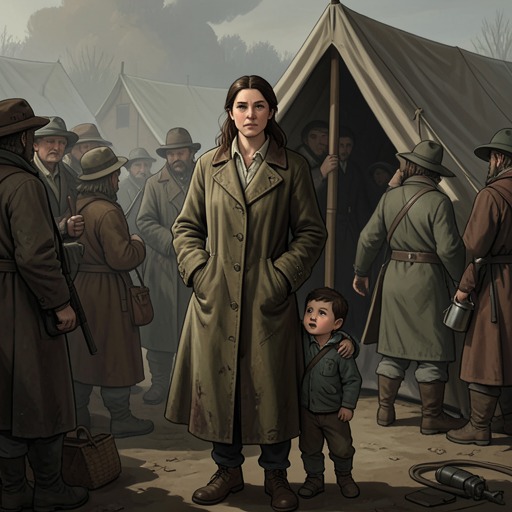
When Delphine first begins paying attention to Eva’s children, she recognizes that Markus and Franz dislike Tante. Markus is not yet nine. He is reclusive and polite, with an inward, philosophical cast, though he can play with unrestrained energy. His schoolwork follows his interests rather than a steady pattern: one year his grades are perfect, the next poor. He resembles Eva in his long hands, red-gold hair, and thin face; his eyes can seem to register both sadness and amused disbelief. Named for Eva’s beloved father, Markus is especially devoted to his mother. He anxiously runs errands for Fidelis, but Eva’s affection is central to his emotional life. When she draws him close and kisses him, he gently pulls away in the manner of a boy growing up without wanting to hurt her.
At home and around Fidelis, Markus and his brothers are subdued, though their play elsewhere is inventive and sometimes reckless. The boys make a buggy from discarded springs, wheels, and crates, build rafts from scraps of lumber, and fashion forts, toy weapons, and water-filled bombs from whatever they can find. Their father’s butcher shop imposes a different discipline. On slaughtering days every available hand helps, including the younger boys, who clean gizzards; as they grow, Fidelis teaches them to handle knives safely and intends to train each son in his trade. Markus’s life therefore joins imaginative independence to early work and family obligation.
Grief, Friendship, and Delphine’s Care
Ruthie Chavers is an important presence in Markus’s childhood. After she dies in the cellar, he holds on to the things she gave him rather than accepting her death as final. He hides her gifts in a hole in his pillow: tiny rolled notes, a flattened dime, a small red paper heart, and a tin clicker painted like a cricket. He has decided to think of Ruthie as somewhere else, safe but beyond reach. Among the notes, he carefully preserves the first one she sent, still wrapped around a pencil. The mementos make his refusal of loss tangible: the objects stay within reach even as the friend herself is gone.
Eva’s death leaves Markus with a grief that sometimes arrives before he can explain it. A year later, while exploring an abandoned construction site, he finds a half-dug basement and a huge heap of earth where a planned house was never built. He wanders there alone, and the sensation that the earth has shifted beneath him gives him a moment of comfort. The comfort does not prevent the bouts of crying that trouble him at school; he sometimes has to retreat to the outhouse until he can compose himself. Alone at the site, he lets the tears come without trying to hide them.
The excavation also recalls the day of Eva’s burial. Markus remembers holding a clump of dirt to throw onto his mother’s coffin, then freezing above the grave with his fist closed. Franz had to pry open his fingers, shake the dirt onto the coffin, and lead him away. Markus’s later fascination with digging is thus bound to a moment when he could not perform the expected gesture of farewell. The memory gives his encounter with the earth a personal force: the ground is not simply a place to explore, but a setting where grief and the unfinished act of burial return.
Delphine becomes increasingly attentive to Markus, though she initially feels unfamiliar with children. When she sees his sunburned face and recognizes in it Eva’s steely quality, she senses that the boy understands that his place in her life is about to change. He says little and remains guarded. Later, he remembers Ruthie’s name aloud, and Delphine’s care develops through ordinary routines rather than demands for disclosure. She notices that boys often speak more freely when a woman is occupied with kitchen work, so she draws out cooking and washing chores while Markus talks. Over soup, he tells her about Ruthie’s Valentine and about sleeping inside the hill; he also shares dreams and speaks eagerly of his mother.
The intimacy takes shape in a small gesture. As Delphine turns from him, Markus rests his head against the back of her arm and leans there. She does not move. She understands that he has chosen her again, and privately resolves not to let him go. Her commitment is not biological motherhood but a deliberate promise of care, formed in the space left by Eva and against the possibility that Tante will take the boys away.
The Underground Fort and Its Collapse
A year after Eva’s death, Markus discovers an abandoned building site beyond the woods, a mile or two behind the butcher shop. The basement has been dug, but the owner ran out of money before construction began; the land and an unrepaired shed offer materials for a project. Markus tells Emil and Erich about the place and turns the discovery into a plan for a concealed stronghold. He imagines reinforcing tunnels with boards from the shed and branches from the woods. He also proposes a secrecy oath, sealed when the boys drip hot wax on the insides of their wrists. They steal shovels, use sheets to carry soil out, and store food for the group as they work after school and into the dark.
The project is both a boys’ adventure and a serious construction effort. Markus is the originator of the fort and its rules, and he continues working inside after the others have left the entrance to fetch another board. As he forces a support into the ceiling, the hill settles with a dull internal collapse. The boys outside take several minutes to remember that Markus is still underground. The scene reverses the freedom of their secret world: the hill that was to become their shelter closes over its builder.
Fidelis and Cyprian enter the unstable passage to reach him. The boards the boys placed serve as guides, and Cyprian resets them in the hope that they can bear the weight above. The men continue through the narrow tunnel, where the ground presses close, until they reach a surviving passage at the center of the hill. Fidelis stretches forward and touches the sole of Markus’s shoe. The contact confirms that they have found him, but reaching him does not end the danger.
Markus is unconscious and has a broken arm. Cyprian binds his limbs so he can draw him through the confined passage without the boy moving in pain, then backs out feet first with a rope in his teeth. When they emerge into the rain and the lights, Markus briefly wakes. Delphine is the first face he sees; she unties the ropes and draws him into her arms. His rescue brings the underground episode back to the people who have become his family, making Delphine’s chosen care visible in the moment of his return to the surface.
Illness, Change, and the Family’s Decision
After the collapse, Markus develops an illness beyond the injury to his arm. He becomes feverish and sleepy, and Delphine calls it earth sickness, interpreting the ground’s chill as a force still drawing him toward the place where his mother lies. For a time his gaze seems difficult for her to meet. She eventually recognizes that she should not keep trying to distract him with poems or games: he needs room to think and to grow back into his life. The narrative gives his recovery time and quiet, rather than presenting it as an immediate return to his former self.
His near-burial marks a lasting change. In later life, Markus becomes a reader, develops a studious intelligence suited to quiz competitions, and buys a record player. Music, including the sounds of horns and saxophones, comes from his room. Some teachers send home enthusiastic reports, while others describe him as arrogant. The account contrasts this inward, intellectual adolescence with the boy who once built forts, raced in improvised carts, and threw himself into play. His earlier energy has not simply disappeared; after the collapse, his attention turns toward books, music, and thought.
The family’s plan to travel to Germany is interrupted when Markus becomes gravely ill on the morning they are to leave. His fever is so high that Fidelis goes out before sunrise to find a pharmacy, while Delphine stays beside him. The twins are dressing and looking forward to the departure, but Markus is too unwell to travel. When he later recovers enough to come home, he is cheerful despite his dizziness and says he feels good, though he cannot stand without falling over. Delphine changes his bed and finds his hidden bundle of Ruthie’s notes and the clicker in the pillow. She begins to examine them, realizes that they are private, and puts them back. The scene joins his physical recovery to the persistence of his childhood attachments, while showing Delphine respecting the boundary around them.
Adulthood, War, and Narrative Significance
As an adult, Markus retains the closeness to Delphine established in childhood. When he brings up an important matter at the family table, he struggles to speak: he squares his shoulders, folds and unfolds his hands, drums his fingers on his knees, and addresses the tabletop. He finally says that he has secured clearance and has the papers with him; he plans to leave the next day. The decision takes him toward Ludwigsruhe, the family’s German home, and into a history that has been divided by migration and war.
Markus’s military service brings him into contact with the costs of war at close range. Delphine urges him not to seek combat, describing how men are mutilated and how soldiers can be killed by mistakes made by their own side. She appeals to him on behalf of Eva, Fidelis, and herself, acknowledging that she is not his blood mother while insisting that her care gives her a stake in his survival. Her plea recasts the bond formed after Eva’s death as a genuine family relationship, though it cannot control Markus’s choices.
His adult journey also intersects with the family’s wartime separations. Erich, held as a German prisoner of war, longs for Ludwigsruhe and for the grandfather he adores, while keeping his family at a distance in order to survive captivity. Markus’s plan to travel there and his concern for relatives place him within this divided family history. At another point, he returns to the family table and tells Delphine and Fidelis that he has obtained the necessary clearance, making his decision a concrete step rather than an unspoken wish.
Markus’s arc is shaped by the tension between disappearance and preservation. Ruthie’s notes remain hidden in his pillow; the burial memory returns at the abandoned basement; the fort’s collapse nearly turns the earth into his grave; and Delphine’s care helps him come back into ordinary life without erasing his grief. The child who once could not open his hand at his mother’s grave grows into a reflective adult who can choose where to go and whom to remain connected to. His story makes chosen kinship, memory, and survival inseparable: the family he belongs to is made not only by blood, but by the people who wait, listen, rescue, and keep a place for him.